

Most bettors chase wins without understanding the math behind profitable betting. They celebrate short-term victories and blame bad luck for losses, never realizing that sustainable profit requires a different mindset entirely. Expected value is the mathematical framework that separates professional bettors from casual gamblers. It reveals which bets will generate profit over time, even when individual wagers lose. This guide breaks down how to calculate expected value, interpret the results, and apply this powerful concept to transform your betting strategy from guesswork into data-driven decision making.
Table of Contents
-
Understanding expected value: the foundation of smart betting
-
Nuances and challenges in applying expected value to real bets
-
Comparing EV calculations for different bet types and scenarios
-
How to use expected value strategically to improve your betting results
Key Takeaways
| Point | Details |
|---|---|
| Positive EV profitability | Positive expected value means you can profit over many bets even if individual wagers sometimes lose. |
| Accurate probability estimation | Estimating true win probabilities is difficult but essential for accurate EV calculations. |
| Short term variance | Short term variance means a winning strategy can lose on several consecutive bets. |
| Process over outcomes | Focus on the long term process rather than chasing short term outcomes. |
Understanding expected value: the foundation of smart betting
Expected value represents the average amount you can expect to win or lose per bet if you placed the same wager thousands of times. The expected value calculation uses a straightforward formula: EV = (Probability of Win × Payout) – (Probability of Loss × Stake). This mathematical framework transforms betting from emotional impulse into rational analysis.
Breaking down the formula components clarifies how EV works in practice. Probability of win represents your estimated likelihood of the bet succeeding, expressed as a decimal between 0 and 1. Payout is the total amount you receive if you win, including your original stake. Probability of loss equals 1 minus the probability of win. Stake is the amount you risk on the bet.
Consider a concrete example to illustrate the calculation process. You find a bet at +150 odds (2.50 decimal), meaning a $100 stake returns $250 total if you win. After analyzing team statistics, injury reports, and recent performance, you estimate the true probability of this outcome at 45%. Here’s how the math works:
-
Convert your probability estimate to decimal: 45% = 0.45
-
Calculate probability of loss: 1 – 0.45 = 0.55
-
Determine payout: $250 (your $100 stake plus $150 profit)
-
Apply the formula: EV = (0.45 × $250) – (0.55 × $100)
-
Solve: EV = $112.50 – $55.00 = $57.50
This positive expected value of $57.50 means that if you could place this exact bet 100 times under identical conditions, you would theoretically profit $5,750 total. Each individual bet might win or lose, but the mathematical expectation favors long-term profit.
Pro Tip: A positive EV doesn’t guarantee you’ll win the next bet or even the next ten bets. Variance means short-term results will fluctuate wildly around the expected value. Focus on process over outcomes.
“The goal isn’t to win every bet. The goal is to consistently identify situations where the odds offered exceed the true probability, creating positive expected value over a large sample size.”
Understanding EV transforms how you evaluate betting opportunities. Instead of asking “Will this bet win?” you ask “Does this bet offer value relative to the true probability?” This mental shift separates positive expected value bets from sucker wagers that enrich bookmakers.
Nuances and challenges in applying expected value to real bets
The elegant simplicity of EV formulas masks a brutal reality: estimating true probabilities is extraordinarily difficult. Converting bookmaker odds to implied probability is trivial math, but determining whether those odds accurately reflect reality requires sophisticated analysis. The gap between theoretical EV and practical application explains why most bettors lose despite understanding the concept.
Short-term variance creates psychological challenges that derail even mathematically sound strategies. A bet with 60% win probability and positive expected value will still lose 40% of the time. String together five losses in a row, which happens regularly with 60% win rates, and doubt creeps in. You question your analysis, abandon your system, or chase losses with larger bets. Expected value and variance operate independently, meaning positive EV offers zero protection against painful losing streaks.
Several factors compound the difficulty of reliable EV calculations in real betting scenarios:
-
Incomplete information about injuries, lineup changes, weather conditions, and motivation levels
-
Rapidly changing odds that eliminate value before you can place the bet
-
Bookmaker limits that prevent meaningful stake sizes on profitable markets
-
Correlation between related bets that standard EV formulas don’t account for
-
Psychological biases that skew probability estimates toward desired outcomes
-
Limited historical data for unique situations or new betting markets
Market efficiency presents the most fundamental challenge to profitable betting. Sports betting market efficiency research demonstrates that markets largely incorporate available information into odds quickly and accurately. Overoptimistic bettors collectively generate returns around negative 7.5%, slightly worse than the typical bookmaker margin. Finding genuine edges requires information advantages, superior analytical models, or faster execution than the market.
The confidence you feel in your probability estimates rarely matches their actual accuracy. Bettors systematically overestimate their ability to predict outcomes, leading to inflated win probability estimates and false positive EV calculations. Without rigorous tracking and honest assessment, you’ll convince yourself that losing bets were unlucky rather than poorly analyzed.
Advanced bettors address estimation uncertainty through sensitivity analysis and confidence intervals. Instead of assuming your 55% win probability estimate is precise, test how EV changes if the true probability ranges from 50% to 60%. This reveals whether the bet remains profitable across your uncertainty range or only at your optimistic estimate. Disciplined analysis acknowledges what you don’t know.
“The market doesn’t care about your analysis. It only cares whether you have information or insight that other participants lack. Without an edge, positive EV is an illusion.”
Recognizing these challenges doesn’t mean abandoning EV analysis. It means approaching betting with appropriate humility, rigorous record keeping, and realistic expectations about the difficulty of sustained profitability.
Comparing EV calculations for different bet types and scenarios
Expected value formulas adapt to different betting structures, with binary proposition bets offering the simplest calculation framework. Binary props present two possible outcomes: the proposition occurs or it doesn’t. Player props like “Over 2.5 goals” or “First team to score” fit this category. The binary props expected value formula simplifies to: EV = (P_win × Profit) – (P_lose × Stake).
This streamlined approach clarifies the relationship between probability, odds, and value. Consider a player prop at -110 odds (1.909 decimal) where you estimate 55% win probability. Your profit on a $100 bet equals $90.91 (the payout of $190.91 minus your $100 stake). Calculating EV:
-
EV = (0.55 × $90.91) – (0.45 × $100)
-
EV = $50.00 – $45.00 = $5.00
-
ROI = $5.00 / $100 = 5%
A 5% ROI represents exceptional value in efficient betting markets. Most professional bettors consider anything above 2-3% ROI sustainable long-term performance. This example demonstrates why small edges compound into significant profits over large bet volumes.
Comparing EV formulas across common bet types reveals important structural differences:
| Bet Type | EV Formula | Key Consideration |
|---|---|---|
| Binary prop | (P_win × Profit) – (P_lose × Stake) | Simplest calculation, clear two-outcome structure |
| Moneyline | (P_win × Payout) – (P_lose × Stake) | Must account for different payout structures for favorites vs underdogs |
| Point spread | (P_cover × Profit) – (P_fail × Stake) | Requires estimating probability of covering specific margin |
| Parlay | (P_all_win × Payout) – (P_any_lose × Stake) | Probabilities multiply, creating exponentially lower win rates |
| Live betting | Dynamic EV based on current game state | Odds and probabilities shift constantly during play |
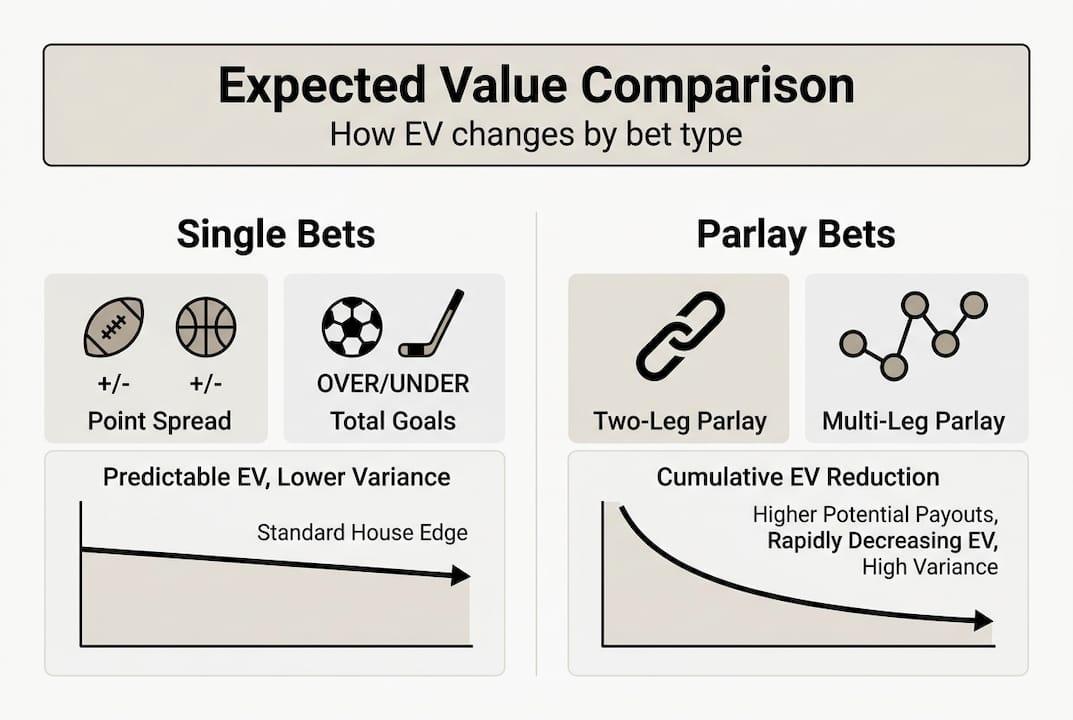
Parlays illustrate how bet structure dramatically impacts EV despite using the same underlying formula. A two-leg parlay combining 55% probability bets offers combined win probability of only 30.25% (0.55 × 0.55). The increased payout rarely compensates for the multiplicative probability decrease, making most parlays negative EV even when individual legs offer value.

Pro Tip: Stick to bet types where you can estimate probabilities most accurately. If you excel at analyzing total goals but struggle with first-half spreads, focus your betting on markets matching your analytical strengths.
Different bet types present varying levels of market efficiency. Mainstream markets like NFL point spreads incorporate vast amounts of information and sharp money, making edges scarce. Niche props on lower-tier leagues receive less analytical attention, potentially offering more frequent value opportunities. However, these markets also feature lower limits and higher bookmaker margins.
Understanding how expected value in varied bet types operates allows you to allocate research time efficiently. Master EV calculation for your preferred betting markets before expanding into unfamiliar territory.
How to use expected value strategically to improve your betting results
Calculating expected value means nothing without disciplined execution and proper bankroll management. Positive EV bets still carry risk, and poor bet sizing can bankrupt you despite identifying genuine edges. Strategic EV application requires systematic processes that protect capital during inevitable downswings while maximizing growth during winning periods.
Integrating EV into your decision-making framework follows a clear sequence:
-
Research the event thoroughly using relevant statistics, trends, and situational factors
-
Estimate win probability independently before checking bookmaker odds
-
Calculate expected value using your probability estimate and available odds
-
Compare EV across multiple bookmakers to find the best available line
-
Determine appropriate stake size using bankroll management principles
-
Track results meticulously to validate your probability estimation accuracy
-
Review losing bets objectively to identify estimation errors vs normal variance
The Kelly criterion provides a mathematical framework for optimal bet sizing based on your edge and bankroll. The formula calculates the ideal stake percentage as: (Edge / Odds). If you have a 5% edge on a bet at 2.00 decimal odds, Kelly suggests risking 2.5% of your bankroll. This approach maximizes long-term bankroll growth while limiting ruin risk.
Most professionals use fractional Kelly (typically 25-50% of the calculated amount) to account for probability estimation errors and reduce volatility. Full Kelly assumes perfect probability knowledge, which no bettor possesses. Conservative sizing protects against the inevitable estimation mistakes that plague even sophisticated analysis.
Bankroll management matters more than most bettors realize. Kelly and value betting strategies help but simulations rarely beat the bookmaker margin consistently without exceptional edges. Proper sizing ensures you survive long enough to benefit from your positive EV bets when variance eventually regresses to expectation.
Discipline separates theoretical EV understanding from practical profitability. You must resist the temptation to increase stakes during losing streaks or bet on marginal edges because you want action. Every bet should meet your minimum EV threshold regardless of how long since your last wager. Boredom and impatience destroy more bankrolls than bad analysis.
Tracking results serves two critical functions. First, it provides honest feedback about your probability estimation accuracy. If your estimated 60% win rate bets only win 52% over 200 trials, your estimation process needs refinement. Second, detailed records help identify which bet types, sports, or situations generate your best results, allowing you to specialize strategically.
Pro Tip: Set a minimum EV threshold (like 3% ROI) and only bet when opportunities exceed that standard. Forcing bets on marginal edges guarantees long-term losses once variance and estimation errors factor in.
Applying expected value successfully requires patience, discipline, and realistic expectations. Professional bettors measure success in ROI percentages and sample sizes, not individual wins. Adopt this mindset and you’ll make better decisions under uncertainty.
Discover tools to identify winning bets
Calculating expected value manually for every potential bet consumes enormous time and mental energy. Professional tools streamline the process, highlighting opportunities that meet your criteria while filtering out negative EV propositions. Betynex provides AI-powered analysis that identifies value across multiple sports and bet types, saving you hours of research.
Our winning bets page aggregates positive expected value opportunities from major leagues and events. The platform compares bookmaker odds against probability models, flagging situations where the market may be mispricing outcomes. Instead of manually calculating EV for hundreds of potential bets, you focus your analysis on the most promising opportunities.

Tracking features let you monitor performance across bet types, sports, and time periods. This data reveals whether your results align with expected value predictions or if systematic biases are undermining profitability. Review past predictions to validate model accuracy and refine your betting strategy based on actual outcomes rather than assumptions. Data-driven insights bridge the gap between theoretical knowledge and practical success.
Frequently asked questions
What is expected value in betting?
Expected value represents the average profit or loss you can expect per bet over many repetitions. It combines the probability of different outcomes with their associated payouts to calculate a single number indicating long-term expectation. Positive EV means the bet should profit over time, while negative EV indicates expected losses.
How do you calculate expected value for a bet?
Use the formula EV = (Probability of Win × Payout) – (Probability of Loss × Stake). First estimate your win probability as a decimal between 0 and 1. Multiply this by the total payout you’d receive if you win. Then multiply your loss probability by your stake amount and subtract this from the first result. The final number shows your expected profit or loss per bet.
Why do positive expected value bets sometimes lose?
Variance causes individual outcomes to deviate from mathematical expectation. A 60% win probability bet still loses 40% of the time, and random clustering can produce extended losing streaks. Expected value only manifests over large sample sizes, typically hundreds or thousands of bets. Short-term results fluctuate wildly around the long-term average.
Can expected value guarantee consistent profits?
No, because market efficiency makes finding genuine positive EV opportunities extremely difficult. Most betting markets incorporate available information quickly, eliminating edges before you can exploit them. Additionally, probability estimation errors often create false positive EV calculations. Sustainable profitability requires information advantages, superior models, disciplined execution, and proper bankroll management to survive variance.